Key moments
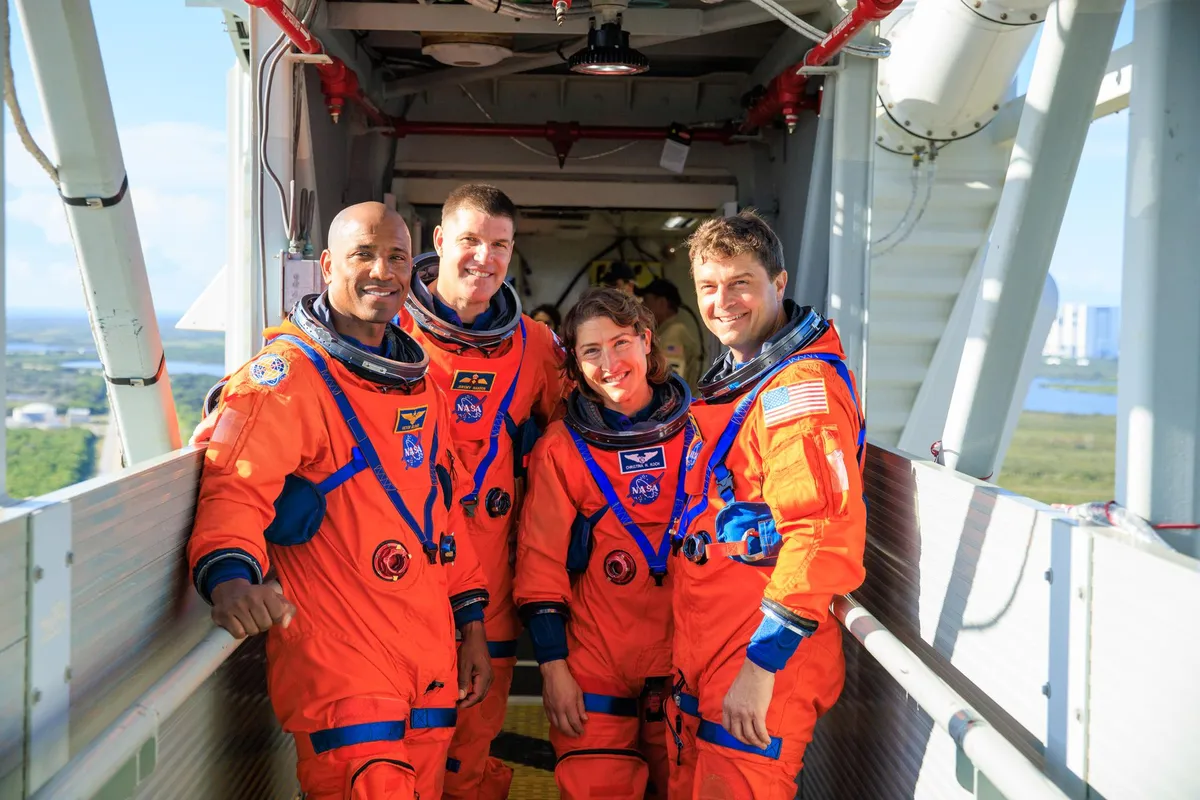
NASA has officially announced the crew for the Artemis II mission, which is scheduled to launch on April 1, 2026, from the Kennedy Space Center in Cape Canaveral, Florida. This mission will include NASA astronauts Reid Wiseman, Christina Koch, Victor Glover, and Canadian astronaut Jeremy Hansen, marking a significant milestone in human space exploration.
The Artemis II mission is designed as a 10-day journey that will take the crew on a trajectory around the moon, aiming to send them farther from Earth than any human has gone before. This mission will surpass the Apollo 13 distance record of 248,655 miles, setting a new benchmark for future lunar exploration.
This mission will also be historic as it marks the first time that NASA’s Space Launch System (SLS) rocket and Orion capsule will carry human passengers. Reid Wiseman will command the mission, with Victor Glover serving as pilot and Christina Koch and Jeremy Hansen as mission specialists. The crew will conduct various science experiments and test systems aboard the Orion capsule during their flight.
Christina Koch, who holds the record for the longest single spaceflight by a woman at 328 days, expressed her enthusiasm for the mission. Meanwhile, Victor Glover made history as the first Black astronaut to live and work aboard the International Space Station in 2020 and 2021. Jeremy Hansen will become the first Canadian to venture to the moon, further emphasizing the international collaboration in space exploration.
The Artemis II mission is the second outing for NASA’s SLS rocket and Orion capsule, following the uncrewed Artemis I flight. The mission will conclude with a splashdown in the Pacific Ocean, marking the end of a significant chapter in NASA’s Artemis program.
In a statement, Reid Wiseman said, “The four of us, we are ready to go. The team is ready to go. The vehicle is ready to go.” Christina Koch added, “Success is Artemis 100, whenever that is,” highlighting the long-term vision of NASA’s Artemis program.
As humanity prepares for this mission, Kelsey Young noted, “The moon is like such a unifying thing,” reflecting the broader significance of lunar exploration for future generations. NASA plans for the Artemis IV mission to land astronauts on the moon in 2028, continuing the legacy of lunar exploration that began with the Apollo program.