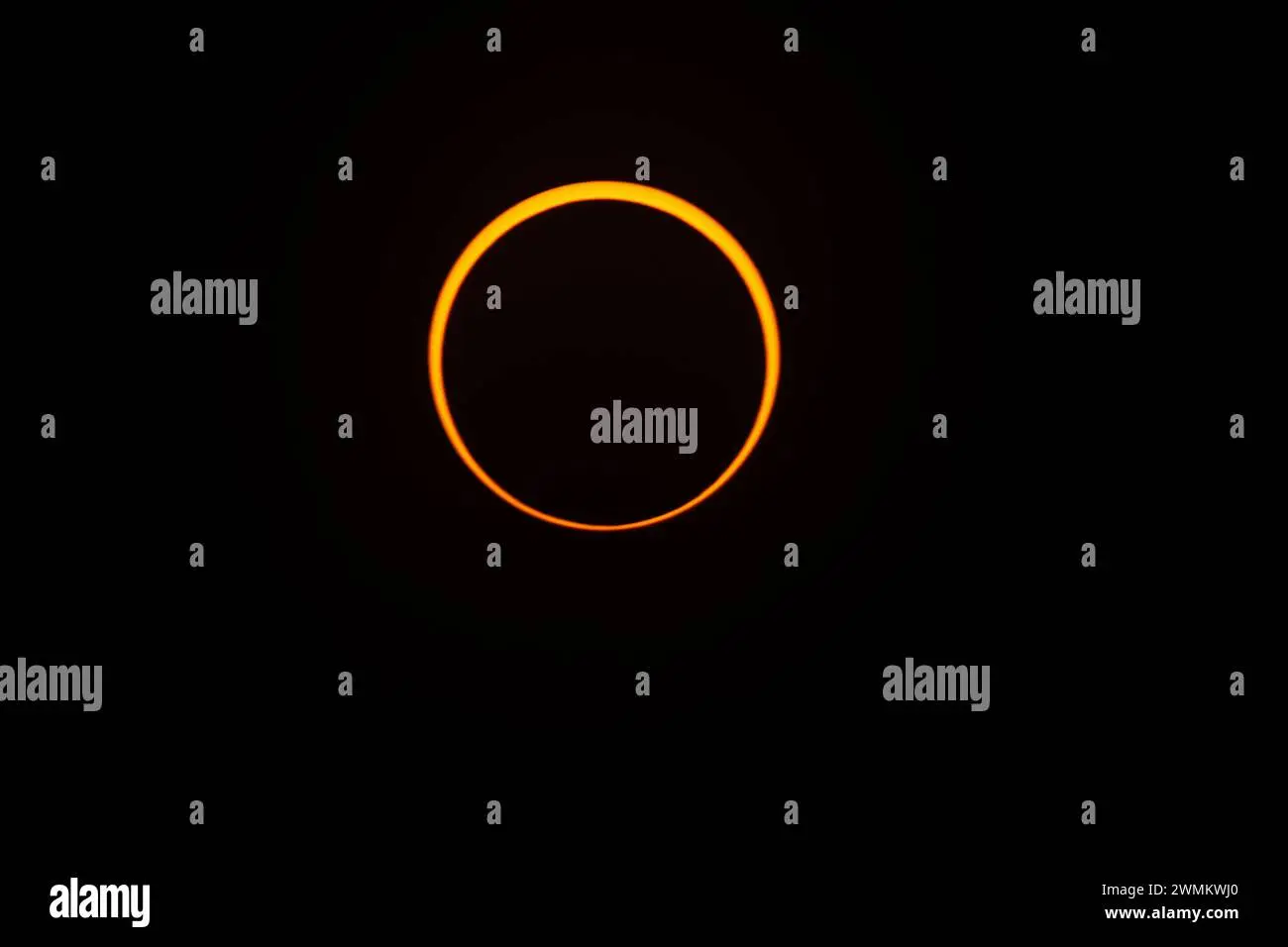
Understanding the Annular Solar Eclipse
An annular solar eclipse occurs when the Moon passes between the Earth and the Sun but is too far away to completely cover the Sun, resulting in a stunning “ring of fire” effect. This celestial event is not just a visual spectacle; it holds scientific significance as well, making it relevant for both astronomy enthusiasts and casual observers alike.
Details of the 2023 Annular Solar Eclipse
The next annular solar eclipse will happen on October 14, 2023. This event is anticipated with much excitement as the path of annularity will cross parts of the United States from Oregon to Texas. Areas within this path will experience the full effect of the ring of fire, while outside this area, observers will see a partial solar eclipse.
The eclipse is expected to begin at approximately 11:13 AM PDT in Oregon, gradually moving southeast across the U.S. with its peak occurring around 12:27 PM CDT in Texas. In total, the annular phase will last for about 2 to 5 minutes, depending on the observer’s location.
Significance of the Event
Events like this not only increase public interest in astronomy but also provide opportunities for scientific observation. Physicists and astronomers will take this opportunity to conduct research related to the Sun’s corona and the behavior of solar phenomena. Historically, eclipses have aided scientists in testing theories, such as Einstein’s general theory of relativity when light from stars was observed bending around the Sun during an eclipse in 1919.
Viewing Safety Tips
While the annular eclipse offers a breathtaking sight, it is crucial to observe it safely. Regular sunglasses are not sufficient for viewing the Sun. Instead, viewers should use solar viewing glasses that meet the ISO 12312-2 international safety standard or use solar filters on telescopes and binoculars. Even during an annular eclipse, looking directly at the Sun can cause permanent eye damage.
Conclusion
The annular solar eclipse on October 14, 2023, represents more than just a rare astronomical event; it serves as an educational opportunity and a reminder of the wonders of our universe. As the excitement grows leading up to the eclipse, communities along the path are preparing for viewings, encouraging public engagement in science and astronomy. It’s a moment not to be missed for anyone interested in the natural world wherever they are located.