“NATO is a paper tiger,” stated former President Donald Trump, reflecting a sentiment that has sparked considerable debate about the future of the North Atlantic Treaty Organization. This remark underscores the ongoing discussions regarding the alliance’s strength and the implications of potential changes in US involvement.
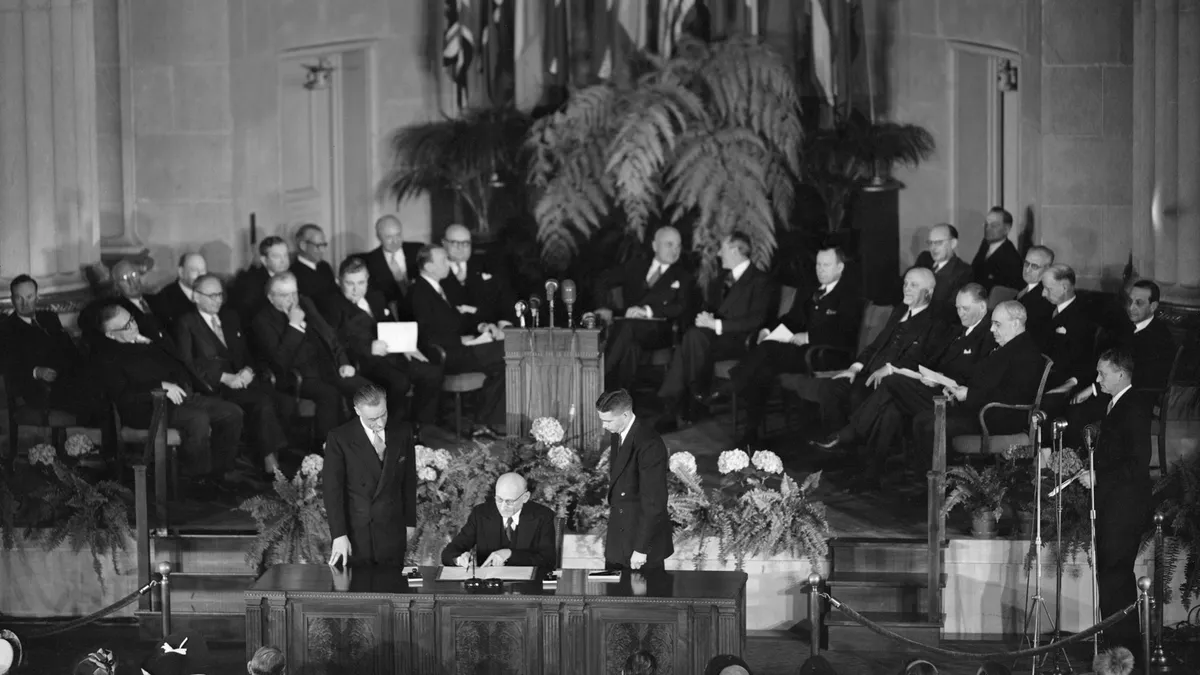
NATO, which stands for the North Atlantic Treaty Organization, has been a cornerstone of collective defense since its inception. The organization relies heavily on the military support and nuclear assurance provided by the United States, which has historically played a crucial role in NATO’s operations.
According to NATO Secretary General Mark Rutte, “The US umbrella remains the ultimate guarantor of European security.” This statement highlights the critical nature of US participation in the alliance, especially in light of increasing defense spending among NATO’s European members and Canada, which saw a 20% increase in 2025.
Recent legislative developments have also brought attention to the complexities surrounding US withdrawal from NATO. The US Constitution requires two-thirds Senate consent for treaties but is silent on the process of withdrawal. However, Section 1250A of the 2024 National Defense Authorization Act specifies that the president may not withdraw from NATO without two-thirds Senate consent or an Act of Congress.
Furthermore, NATO’s treaty stipulates that a one-year notice is required before any withdrawal takes effect, adding another layer of complexity to the issue. Experts warn that a formal US withdrawal from NATO would be catastrophic, potentially destabilizing the security landscape in Europe.
In recent years, Poland, Lithuania, and Latvia have surpassed the 3.5% GDP benchmark for core defense spending, indicating a shift in the commitment of NATO’s European members to bolster their military capabilities. This increase reflects a growing recognition of the need for enhanced defense in the face of evolving threats.
Should the US withdraw from NATO, analysts suggest that the alliance would need to establish a local operational core centered around Britain, France, Germany, Poland, and the Baltic-Nordic states to maintain its effectiveness.
As discussions continue, the future of NATO remains uncertain. The alliance’s ability to adapt to changing geopolitical dynamics will be crucial in determining its relevance and effectiveness in the years to come.
Details remain unconfirmed regarding the specific impacts of potential policy changes on NATO’s structure and operations, but the dialogue surrounding its meaning and significance is more pertinent than ever.